Walk into almost any lab and you'll find three humble machines doing a surprising amount of the work: the hot plate, the water bath and the magnetic stirrer.
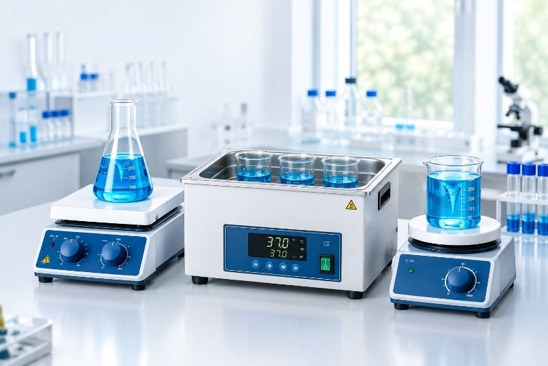
They look simple. They aren't. Pick the wrong one and you get uneven heating, spoiled samples or, worse, a flammable solvent sitting next to a hot surface.
Here's how to choose with confidence, whether you're equipping a new lab or replacing tired kit.
Hot Plates: Direct, Controllable Heat
Best for: boiling, evaporating and heating beakers and flasks.
What to look for:
- Stepless temperature control. A smooth dial lets you fine-tune heat instead of jumping between fixed settings.
- Surface material. Ceramic tops resist spills and corrosion. Bare metal heats quickly but can pit over time.
- Surface size. Match it to your largest flask, with a little margin.
- Stability and safety. A solid base and a clear hot-surface indicator matter more than they sound.
Watch out: a hot surface can ignite solvent vapours. For flammables, use a water bath instead.
Magnetic Stirrers: Hands-Free Mixing
Best for: dissolving solids, keeping suspensions uniform and running long reactions without babysitting.
What to look for:
- Capacity. Thick liquids and larger volumes need a stronger magnet.
- Speed range. You want gentle stirring for delicate work and enough power for denser mixtures.
- Heat-and-stir models. A combined unit saves bench space when you need to warm and mix at once.
- Stir bars. Buy several sizes. They vanish faster than any other lab item.
Water Baths: Gentle, Even, Repeatable
Best for: incubation, warming samples, melting and heating flammables safely.
What to look for:
- Temperature range. Up to 100 °C covers most routine work.
- Even heating. Water spreads heat uniformly, which is why it's the choice for sensitive samples.
- A lid. It cuts evaporation and keeps contaminants out.
- Water quality. Use distilled water to prevent scale on the heating element, and change it regularly.
The Quick Decision Guide
- Need to boil or evaporate quickly? Hot plate.
- Need to mix while dissolving? Magnetic stirrer (heat-and-stir if you also need warmth).
- Need gentle, steady warmth or incubation? Water bath.
- Working with flammable solvents? Water bath, never an exposed hot surface.
Five Questions to Ask Before You Buy
- What volume and how many samples will you run at once?
- What temperature range do you really need?
- Are the chemicals corrosive or flammable?
- How much bench space and power do you have?
- Who supports it if something goes wrong?
That last question is the one most buyers skip. A cheap unit with no after-sales backing can cost more in downtime than a better one would have cost upfront.
Don't Forget the Supporting Cast
A hot plate on its own doesn't get much done. You'll also want a reliable laboratory thermometer, tongs for hot glassware, wire gauze for even heat distribution under flasks, and borosilicate glassware that can handle thermal stress. Buying them together keeps everything compatible and saves you a second round of ordering.
Where to Look Next
At LIFORAMED, our laboratory range includes hot plates with stepless temperature control, magnetic stirrers with combined heat-and-stir options, and water baths for incubation up to 100°C, along with the thermometers, tongs and glassware that go with them.
Not sure which setup fits your workload? Tell our team what you're running, and we'll help you narrow it down before you commit.